This site refers to various downloadable results of the simulation tools and results that are gradually updated with our recent computations at SU Opava (CZ).
Accreting black holes: QPOs across the entire range of mass
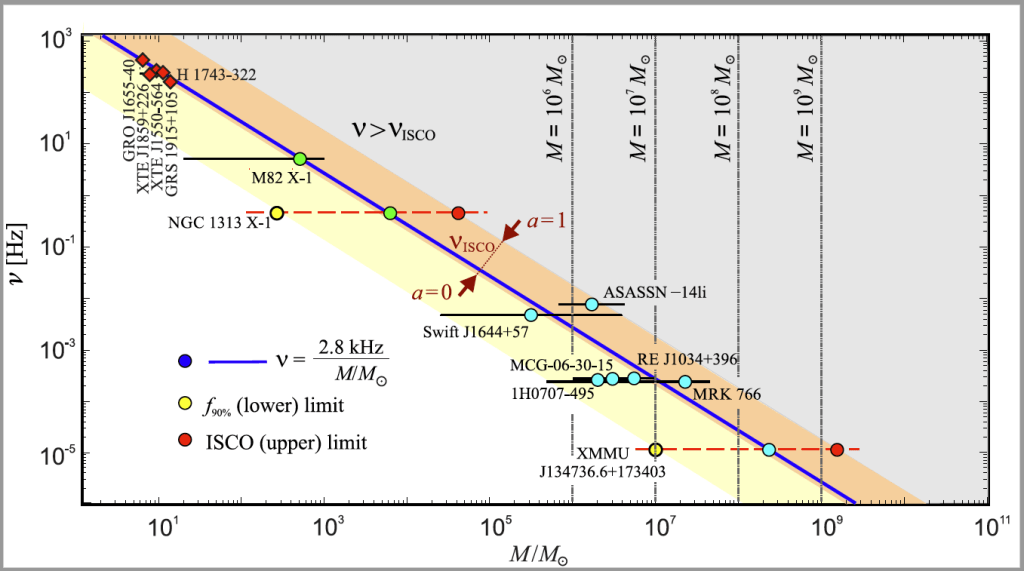
Figure 1.Quasi-Periodic Oscillations from accreting black holes across the range of mass. Enhanced sensitivity and a multitude of instruments will make eXTP an ideal mission explore accretion flow oscillations from variety of black holes over the range of mass. Whereas the upper left section of the plot corresponds to stellar-mass black holes in microquasars observed in the Milky Way, the lower right section is populated by supermassive black holes in cores of active galaxies. The coloured band spanning towards top right corner indicates the uncertainty range corresponding to the spin parameter in the range from non-rotating black hole (a=0) up to maximum rotation (a=1). The coloured band spanning towards bottom left corner corresponds to the inner part of the standard (Keplerian) accretion disk that radiates more than 90% of the entire disk luminosity. Figure has been amended from the original work of Goluchová et al. (2019) by revising data points for several objects and including additional sources.
Accreting neutron stars: spots and surface structures
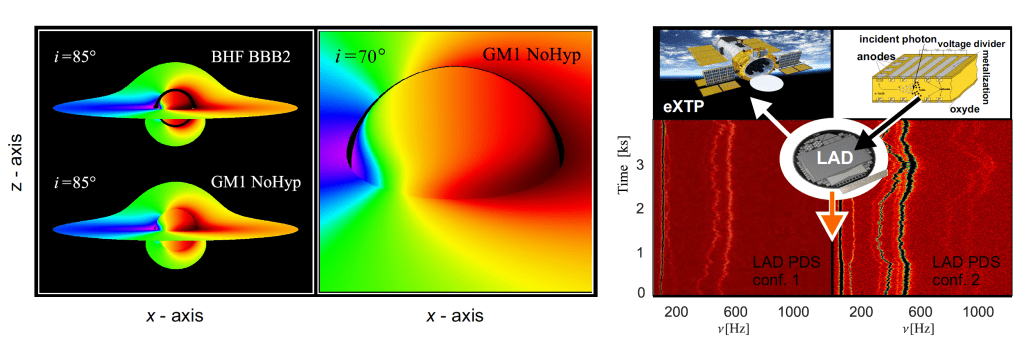
Figure 2.Left: Images illustrating Doppler shifts effects for Keplerian discs around a rotating neutron star (NS). These are calculated assuming the same NS mass and spin frequency but two different NS equations of state (EoS). An emphasized view shows NS spreading layer where matter from the discs enters the rotating NS surface. Illustration based on Šprňa et al. (2023, in prep.). Right: The LAD detector on board of eXTP satellite (isdc.unige.ch/extp) and examples of simulated time evolution of the X-ray variability of NS’s accretion disk as predicted for the LAD detector (Bakala et al., 2014; Zhang et al., 2016; De Rosa et al., 2019; Feroci et al., 2022).